I started playing D&D when I was 19. I was an ALC kid who got a diploma without reading too many books, and my literary influences were Grand Theft Auto, the movie Troy, and pro wrestling. I didn’t even like the Lord of the Rings movies. That was the norm at our table though, and we played the game all wrong and absolutely loved our broken-beyond-all-repair homebrew. Because broken as it was, the magic of the game still shined through. It was story-telling, it was invoking something beyond ourselves.
The 3.5 core rulebooks were probably the first books I read for pleasure since 8th grade (Stephen King’s The Stand), and while it showed the many game mechanics we were screwing up in our game, it was also my first road map for worldbuilding. In gaming and fantasy we throw that word around enough that it’s meaning has become dull, but take a second and whisper those words…“world building,” and imagine learning for the first time in your life that you have that power. It spurred a hunger for knowledge. I mean, if I’m going to create worlds, then I had to start learning about the world I actually live in. (Because despite all the bad news always flooding our brains, all in all, it’s an awesome world). I started with documentaries from the History Channel (20 years ago mind you!) and the Science Channel, and then when I deployed to Iraq, I gave in and started reading for pleasure. And have kept reading for the last two decades.
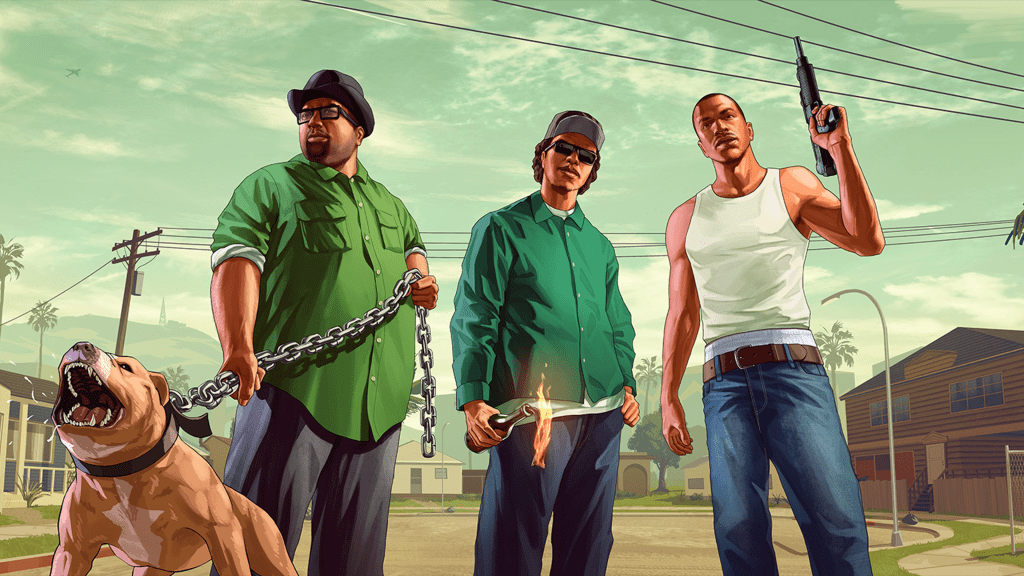
The fantasy worlds and the heroes and villains who lived there opened so many doors I never knew existed. Dragonlance, Dark Elf Saga, Song of Ice and Fire, Dune, Wheel of Time, Malazan, Hobbit, Lord of the Rings (I grew wiser and came to love the movies too. I was like a child who thought I didn’t like mustard.) For sure the most important book I found was The Hero with a Thousand Faces by Joseph Campbell. What I at first thought would be a how-to of telling a hero’s journey (the shallowest of possible takeaways from Campbell’s work) instead became a spiritual document of the power of symbol, myth, and storytelling. It became the why? rather than the how? of the fantasical(More on Campbell another time). Meanwhile, the games I ran and the worlds I drew up became more vibrant, more dangerous, more magical, more alive. With all due respect to CJ and the Grove Street Family, I had come a long way from basing quest lines off GTA missions and homebrewing in the “Respect” stat!
The one thing I hadn’t adjusted in my Dungeon Mastering was the systems I used. Sure, I jumped from D&D 3.5 and D20 modern to Pathfinder 1e, but that’s like switching from Coke to, well…Coke. Losing the ability to run in-person games during the pandemic led me to give 5e a try though, and while you wouldn’t think D&D 5e would be the gateway drug to OSR, it put me in a place where as a DM, I had to learn the rules all over again.
What set me down the rabbit hole of games was 5e’s stubborn decision not to list prices for magic items. “Hold an auction or go on a quest for it,” they told me. Reading through some of the pricing listed and magic item limitations told me I didn’t know how to balance the loot yet, and I didn’t want a busted homebrew. So after 16 years of playing, I ran my first module. I researched which modules had the least railroading, and went with Tomb of Annihilation (I just now stopped and said, “That can’t be how you spell anhialation.” Always learning) and as much hate as I see directed toward 5e, that module delivered. It sucked me deeper into D&D lore too. Who is Acererak? What’s Chult? Who are Artus Cimber and Dragonbait? I need to know more about Spheres of Annihilation (that’s really how you spell it, huh?)
Maybe it’s time to switch to Pepsi?
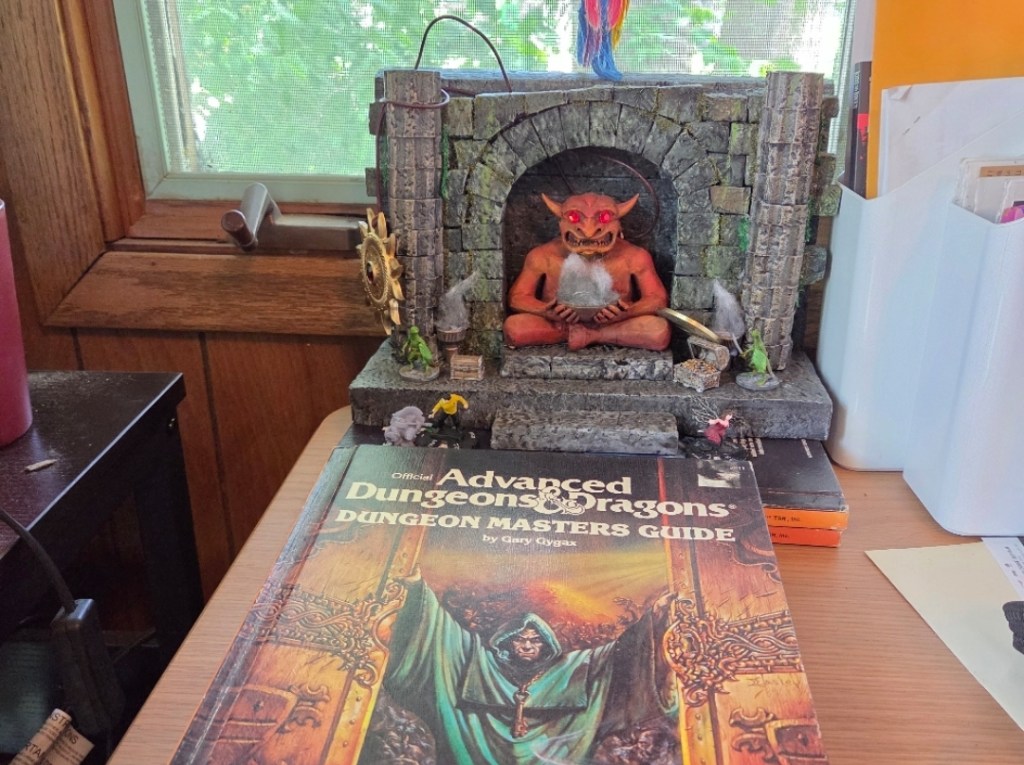
D&D lore, like any system of myths with multiple storytellers, is a mess. It’s retconned, and re-retconned, and contradictory, and bloated. It’s wrecked homebrew upon wrecked homebrew made canon. So I said, “start at the beginning,” and read through the AD&D corebooks (I know now that wasn’t the beginning) and had a chance to play some of it with Jeff Leason at the Dungeon Hobby Shop during its brief and troubled tenure in Lake Geneva. Going back in time system-wise helped me make sense of in-game things I had never considered. (Why do druids have their own unteachable language? Why are 3.5e spellcasters COMPLETELY broken?) When I started looking for more people talking about AD&D on Twitter, I found the hastags #OSR and #BROSR came up a lot.
That was when I found the treasure troves of hobby wisdom: Grognards and Bros. People who have been playing since the hobby was new, people examining the old texts for new answers, people experimenting on a system level rather than asking if [Insert IP here] can be run using 5e? People who delve. People who read and study and play games rather than listen to famous people pretend to play. Do they fight a lot amongst each other and with everyone else about silly shit? They sure do! But they’re the lifelong students of the hobby. I did the fly on the wall for a long time, learning, asking the occasional question or chiming in, but mostly getting oriented.
Appendix N came up a lot in the discourse. It’s a list of authors, series, and books Gary Gygax lists as his inspirations in the formation of AD&D. I’ll admit, at first I thought it was folks making too much of a bit entry in a book. Like an author saying, “I like these books,” and people saying, “then I will too!” (It brought to mind the Gunters in Ready Player One by Ernest Cline, scouring the creator’s favorite books in search of a hidden easter egg he left in his game.) But the more it was referenced and the more reverence I heard for it from people who were running awesome games (Dungeon Crawl Classics, and also thank you Jeffro), I decided the worst that could happen would be I’d read a few books I didn’t care for and then give up on the list.
Instead, I realized all the fantasy I had been reading and loving, and the games I have been playing were built upon the shoulders of titans. I’ll admit, I’m only 9 books and a handful of stories into it, but the ones I’ve read have each been so evocative in their prose, the endless horizons of their constructed worlds, the point of view of man’s eternal quest for something greater within himself. Rather than being the generations who learned what fantasy is from playing D&D, these authors were explorers into stories and themes and worlds not yet discovered. They were the Apollo crew walking on the moon with 60’s tech before the next three generations played it safe in Earth’s orbit.
So I want to explore Appendix N, book by book. From a literary standpoint? Sure, a little, but I know that’s been done already by folks who had read much more deeply into old Sci/Fantasy before beginning their writing. So I want to look instead to what Appendix N has to teach us as DMs and referees, the things that become flattened by fiction built upon an ever-shifting game that has fallen deep into amnesia when it comes to recognizing its roots.
Other than tweets and a few episodes of the podcast Appendix N Book club, I have not read the secondary sources analyzing Appendix N (Appendix N: the Literary History of Dungeons and Dragons by Jeffro Johnson or Appendix N: the Eldritch Roots of Dungeons and Dragons by Peter Bebergal). I will wait to read those until I’ve read a bulk of the books on the list so I don’t risk regurgitating the points those authors have already made.
I just finished reading Swords and Deviltry by Fritz Leiber (which gave me lesson after lesson until I decided I should make a blog of them) so I will make that the subject of Better DMing Through Reading #1.
If you’re interested in Appendix N and want to keep up with my journey, feel free to subscribe. Or you can chat with me on Twitter (where I’m guessing a bulk of my readers know me from) @mawrundown. Profile Name: Dance Commander.
(After tuning into @DunderMoose podcast the other night and hearing @Gingerblast and @JacobLeTourneau describe their Braunstein #1 experience, I figured I would compare DaveCon’s Braunstein #1 to the Braunstein #4 I played in at Arnecon.)
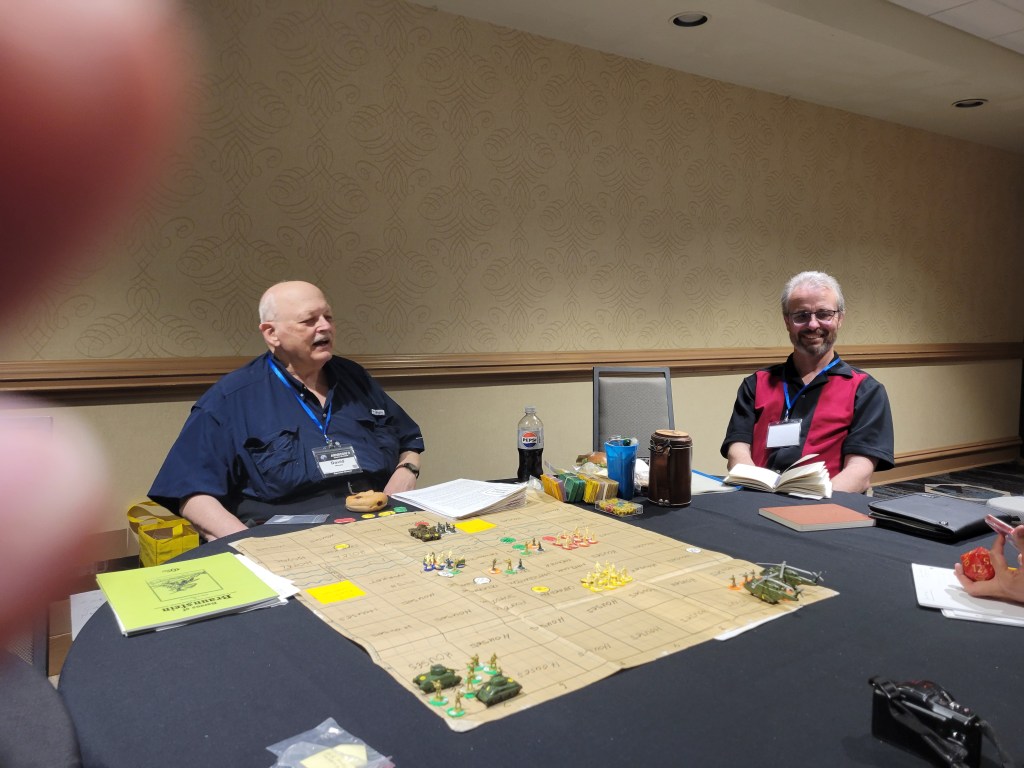
Starting Set-up at Braunstein #4. at Arnecon 2024. Also pictured: Maj. David Wesley, the talented @DragontimeDM (Minister of Information) and the famous Brown Stein. (Please excuse my fat chunky fingers in the picture!)
At Arnecon 2024, I had the pleasure of playing in Maj. David Wesley’s Braunstein #4 (Banania). I had seen the Braunstein described in “Secrets of Blackmoor” and had read posts about it (mostly from BROSR accounts), and the game definitely lived up to the hype. I played alongside/against a friend from my main home game, and we both agreed it was the coolest gaming session we had ever been a part of. I was also taken by the history of how it came to be, and Arnecon specifically cultivates an appreciation for the deepest roots of the hobby.
I hyped it to all of the players in my home games, and when Davecon 2025 announced Braunstein #1 (Braunstein), I was stoked. The schedule didn’t line up for any of my players except my wife, who joined me in my Saturday games. I can’t emphasize enough how much I put this game on a pedestal to her. “It’s like magic.” I definitely had to eat some crow (pun intended @gingerblast) on that one, because Braunstein #1 did not live up to my hype. My wife described it as “I had fun in the game, but I don’t think I was meant to.” And this summed it up well. I had a great time during the scenario itself (tensions with my revolutionary son, intrigue, playing the baron as insufferably as I could) but it was fun because the players made it fun. With a little guidance, we did what comes naturally to children, and we played make-believe. But this wasn’t Banania. Not by a long shot.
So what was so much better about Banania? Why did Braunstein feel so mundane by comparison? It’s been 7 months since Banania, but I’ll do my best to remember and highlight the differences.
Briefing
Braunstein had a mega-briefing. Around 30 minutes on the birth of the RPG itself (fascinating) followed by 60+ minutes of European history (Holy Roman Empire, 30 years war and the Catholic/Protestant schism, Prussia, American Revolution’s effect on Europe, Smallpox, fictional town of Braunstein’s geography and industry) which was interesting at times, but actually had very little bearing on the game we played. There seemed to be a lot about our characters we didn’t know. Example: As the Baron, I had $300 marks to start the game, but unbeknownst to me, I had $8,000 (more $$$ than anyone else in the game) in the bank. I only learned of this money when the mayor and the banker came asking me to lend some of it out. Other moments I caught: “You can’t arrest the Baron!” after Baron has already been arrested and released; “Only the Holy Roman Emperor can name a chancellor of a university” after the chancellor was arrested and the Baron took his place.
Banania’s briefing was shorter, but still encompassed a total of maybe 45-60 minutes. Because it was set closer to modern times (cold war era), players knew more about the macro-events of the setting, so the brief was mostly RPG history+ fictional Banania geography & industry (which given the presence of a map and the heavy inclusion of industrial issues was all very useful).
Initiating event
In Braunstein, there wasn’t a notable initiating event. Maybe the students going to jail, but that felt more like a starting position for them than like a major event had taken place. Banania, on the other hand, starts with a bang. Turn 0, rebels attack the presidential motorcade and assassinate El Presidente and his body guards. From there, the game is a scramble among key figures to survive/seize power/improve your standing in whatever regime follows. This leads to much greater tension and lends real stakes to your objectives (compared to getting a dance card signed or wooing a milkmaid).
Characters: I wasn’t able to see the full cast of Banania (we had something like 12 players…smaller convention), but every character in play felt like a legitimate power player. I doubled up as the union rep for crocodile leather factory & fieldworkers, other roles I remember: rep from International Banana Company, leather factory owner, heads of military branches (Army, Air Force, maybe others?), American venture capitalist, Minister of Information, Minister of Finance, Minister of Interior, Vice President, Dead President’s Son, head of Secret Police, Bishop of the Catholic church.
Minister of Information could “listen in” on phone conversations, and the head of the secret police could search your character/premises for contraband, and had arresting authority.
And different characters had “troops” to command. Army had tanks & troops, AF commander had troops & choppers, head of secret police (played by the badass Ronin Wong) had a police force, as union rep I had mobs of workers.
Timekeeping
Braunstein was a free-for-all time-wise. Events seemed like they maybe would have taken place over several days? (Considering the revolving door of the jail and that we were able to cross town in roughly 10 seconds to converse with other players). There was nothing to denote time in the game other than the upcoming Debutante’s Ball (which I can’t remember how many days away that was supposed to be from the beginning of the scenario). The problem with this event was that it didn’t even take place in the game, nor was it resolved in the post-game wrap. This led to a bunch of people telling each other how they were going to betray one another and win, but if all of those were true, The Barron (my character) would have been assassinated at least 3 times (all of them well deserved!)
By comparison, Banania had pretty clear time keeping. El Presidente was assassinated early morning (I think 6-ish) and that was round 0. Each round of play after that took place in a time around 60-90 minutes in game, and 30-40 minutes irl. This put the timekeeping somewhere at least near 1:1. The existence of phones made it so you could have a “private” conversation with anyone in the game (though the minister of information could snoop on any phone convo with the wiretap power). In that round, you could also move your character anywhere in town, and order troop movements. (my workers could move 1 square per turn. The grid was 7×8 squares). Movements and actions were executed in the order they were turned in to the referee. (This led to a moment of 2 military commanders racing each other to the referee since their plans were to attack each other.)
Refereeing
In Banania, the referee (Dave Wesley) was always in the room. While we could leave the room and discuss business in the hallway, the referee was ever-present, available to make a ruling if need be or to ask for clarification. Because the game was divided into rounds, he was always there to adjudicate people’s moves. These rounds also served as a touchstone for all the players, getting updated on who was where, moves being made, bombshells that dropped. This also served to make each round unique, as there was always a new reality we as players were grappling with. (I think in total, we had 3 players start a turn by declaring themselves El Presidente on the radio!)
During Braunstein, the referee was in the hallway, and the game took place entirely inside the conference room. This made the referee an afterthought, and without rounds to divide the play and change the facts of the scenario, we were in a sort of limbo in the game where the facts on the ground were whatever someone said they were. Most of the drama was who was arrested or released at any given time, which for the most part, didn’t hold any weight anyway.
The board in the thick of things as a commander moves his troops.
Movement
I had mentioned under timekeeping that Banania included character movement (via automobile) to any location on the map, and troops which could move at various speeds. This made character travel precarious (as you could run into hostile troops, secret police, mobs) but it was still important to go places (to have unmonitored conversations, exchange goods/money). The map itself felt dangerous.
Movement in Braunstein came down to a few designated spots in the room. “Prison” “University” “Mayor’s office” and I think “Bank,” but the only ones that held any meaning were prison and the university. Otherwise we generally sauntered around the room with no real sense of place.
Radio Station
A key point on the map in Banania was the radio station. Holding this not only counted as points at the end of the game (I’ll go into that later) but allowed a player to make broadcasts to the entire game and direct the narrative. At the top of the round, you could make declarations (several new presidents were declared in our session), plant fake stories, etc.
Scheduled Events
I talked about the Debutante’s Ball in Braunstein and how that never came to be, but in Banania, several events were scheduled in the middle of the game. The game took place on a Catholic holiday, and there was a big soccer game scheduled in the afternoon followed by a march by the workers (I think from the presidential palace to the cathedral?) as union rep, these were important events when it came to worker morale and impacted the state of the mob. If the companies forced them to work during the game/march, the mob could be unleashed. It also meant a mass of “troops” near the presidential palace at a key point in the game. The whole game builds to these key rounds.
Objectives
Playing as the Baron of Braunstein, my objectives kept my concerns to a small cast of characters. My drama was getting my son out of jail, keeping him in good standing in school, getting him to give up revolutionary ways (which I handled very directly), and chatting with the mayor/banker. This left many characters that I never had to concern myself with. (Engineers, strangers in town, students who weren’t my son, the doctor, gypsies) I had no connection to their stories, and only learned about any of their drama in the wrap session. While this provides a fog of war, it also makes half of what’s going on irrelevant to me as a player.
In Banania, I couldn’t afford to not talk to everyone. Plots within plots were forming, and everybody had a role to play in the power struggle. I was seeking funds and good treatment of workers, and had a civilian mob as leverage. Everyone in the game had the potential to be useful to me, just as I had the potential to be useful to them. In the end, I backed the side of the conflict that could get me the things I wanted in return for my workers taking up arms. In this scenario, all of the objectives were convergent. The fog of war in this game was in trusting alliances, information. And there was a lot of information that was false (in our game, the weapons shipment that was going to decide this conflict for one side or the other turned out to be a hoax invented by the Minister of Information. He tricked everybody!)
Combat
Braunstein doesn’t have troops at your disposal, so the only combat I am aware of is through dueling. I experienced this first hand as I was scheduled for 2 duels at the end of the game (though Maj. Wesley blew off the 10 year old Chancellor’s duel because “There wasn’t time.”) This was resolved by each side rolling a d6. Odd=hit. Even=miss. One shot death. (The duel ended up being both climactic and anti-climactic, since we kept missing!)
Banania had troop battles, and each character also had a professional bodyguard to serve as their individual combatant. I actually never engaged in any combat, so I can’t speak to the system used to resolve battles.
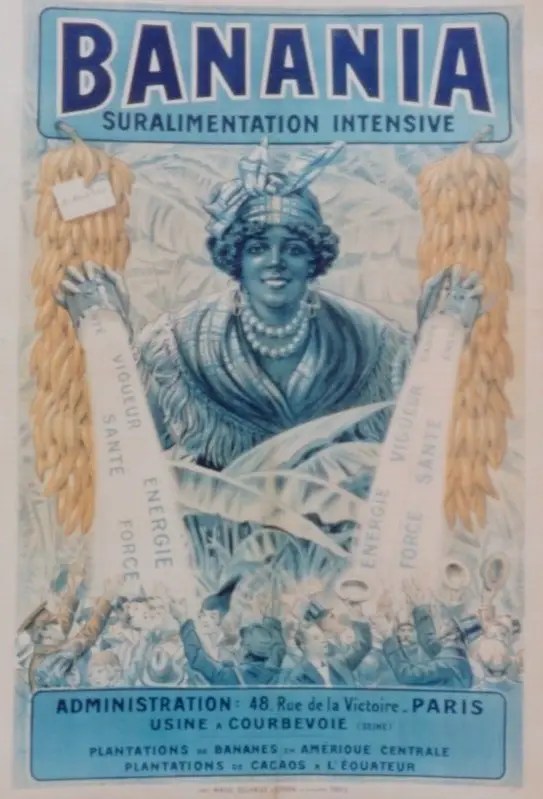
Trademarked in 1915. Don’t even think about calling your game a Banania!
Resolution
While I’ve talked about the Debutante’s Ball and the lack of resolution in that, I would say the real resolution of Braunstein has to do with French spies (the moment during the wrap when all the French spies stand up is quite dramatic. Shows a well-weaved plot in that respect). However, that resolution doesn’t mean as much to the players who weren’t part of the spy game, so it feels like the game abruptly ends for the rest of us (thankfully, the Baron kept things interesting by dueling his son at the end!)
Then there were 2 hours of wrap session, which started interesting (spies stand up, learn of their plot) but drags over time and is derailed A LOT by Maj. Wesley’s side stories (30 minutes about why OK Corral game didn’t make any money, a side tangent about age of consent laws in 18th century Europe and how the eligible bachelorette of the game was like 12!) Seeing as how this wrap session was from 10pm-12am, it felt interminable. (the 6-12 session as a whole felt very long when 2.5 hours were spent in play) Winners were decided by people nominating themselves in 3 categories (who did the most to advance the French cause, who did the most in service to Prussia, and who did the most looking out for themselves.) Winners were selected by show of hands based on who made the best case for themselves, and each received a prize (revolutionary beret, OK corral, Barons of Braunstein. Respectively). All the side stories made keeping track of this a real chore though.
Banania, on the other hand, had a cut and dry, objective resolution. While it’s a game that could be played to attrition, due to time (6 hours doesn’t feel that long in a Banania game) it’s resolved by a combination of victory points and “election.” Certain positions on the map are worth points if they’re held at the end of play (radio station, palace, maybe others) and then there’s a blind vote among the players (as we’re the power brokers of the conflict) which are scored together with the victory points to determine who emerges from the power struggle as El Presidente!
Conclusion
Given the things I’ve read about the new versions of Braunstein-style play (Godstein, Island of War and Winter, On Wine Dark Sea), I think Banania is a much better representation of what this style of play can provide than the prototypical Braunstein #1 (where a majority of the roles were made up on the day of because of how many people showed up).
Braunstein #1 was very thrown together, experimental, and it feels that way. It’s clunky and incongruent, events and characters feel underwritten. But it was the session where they caught lightning in a bottle and brought into this world the 7th type of table top game (first new documented game type in over 2000 years). And replays of Braunstein #1 are like a roadside attraction at the spot where the miracle happened. It has satisfying roleplay and you can sense the unseen hand underpinning the story, but like @gingerblast said, it’s more of a free-form LARP than an actual game. What sets Braunstein #1 apart from the Dinner Theater Mystery genre it’s been compared to, in my opinion, comes down to who was playing the game: a big group of dedicated war gamers who already saw games through the combat game lens and immediately recognized the potential this held.
Braunstein #4 (Banania) exhibits that cross-genre potential in its ruleset. It’s a wargame AND a roleplay. It tracks turns, it allows players to command units, it plans for a means of eliminating other players from the board (by comparison, the duel of the very first Braunstein #1 was famously adjudicated on the fly). There are victory conditions and the potential for ongoing play. It is an early example of what a combat roleplay could be, and a much better example of Maj. Wesley’s (a preeminent wargamer) contribution to the creation of the Role Playing Game (and the forgotten art that many have termed the Braunstein) than his original creation.
As a player, Braunstein #4 was such a superior play experience. The web of lies, the unpredictability, the uncertainty. At one point, the tension felt real: an unescapable life-or-death moment that rested in the hands of other power players. I felt it in my stomach. It gave me some semblance of understanding what it would feel like to live through a government coup. It was a case where the story and the ruleset (content and form) were tightly bound.
As Baron of Braunstein, it felt like I was given a character in improv theater. A few objectives to guide me, a role to make my own. Rather than worry for my survival, I set out to be the most insufferable baron I could be. It was very fun, but the stakes never felt real.
From @gingerblast and @jakelaterneau’s comments on @DunderMoose, both seemed to walk away from Braunstein #1 with the sense that what they were doing had evolved so far past Maj. Wesley’s game that one said they didn’t feel the Braunstein term even applied to what they were doing and there wasn’t a game there, and the other said they felt that the BROSR was the true authority on the Braunstein. I’m not here to dispute either of those claims, but I believe Maj. Wesley’s final Braunstein game Banania is a much more worthy standard-bearer to judge yourself against. Because in Braunstein #4, there’s certainly a game there, and it’s pretty great.




 The Dancefloor